
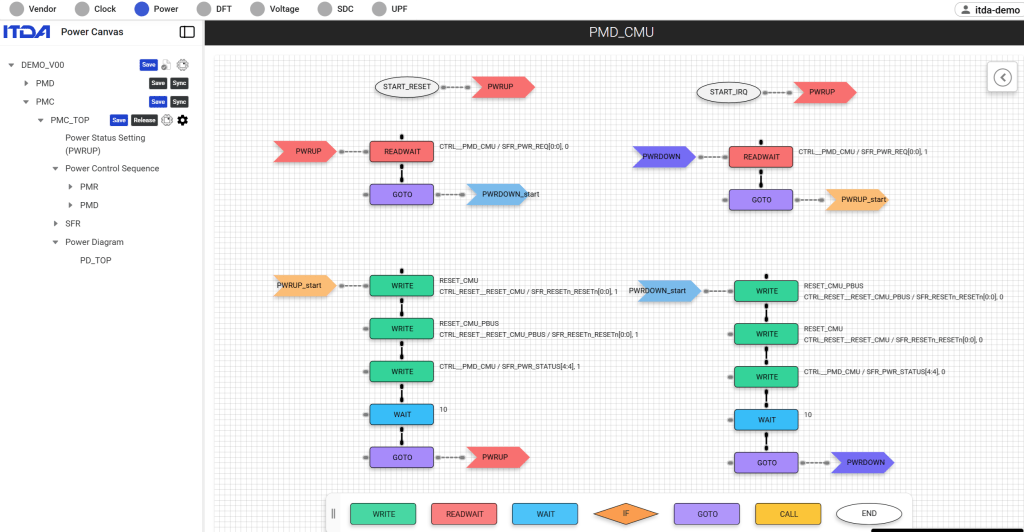
SoCCanvasSeventhDemo – Power Control Sequence
시스템은 “순서”로 동작합니다
🧭 How to design SoC with SoC Canvas
Episode 7에서는
Power Sequence를 flowchart 기반으로 설계하는 과정을 보여드립니다.
Flowchart는 Programmable Sequencer가 수행할 수 있는 Binary로 자동변환됩니다.
각 Power Domain마다 독립적인 Power Sequence를 설계할 수 있고
Power Sequence는 Silicon에서도 지속적으로 Update할 수 있습니다.
✔️ Flowchart 기반 설계
✔️ Binary 자동 생성
✔️ post-silicon 수정 가능
🎥 Episode 7: Power Control Sequence
▶️ 전체 데모 영상이 궁금하신 분들은 댓글이나 DM 주시면 링크를 공유해드리겠습니다.
SoCCanvasSeventhDemo – Power Control Sequence
Systems Operate in “Sequence”
🧭 How to design SoC with SoC Canvas
In Episode 7,
we demonstrate the process of designing a Power Sequence based on a flowchart.
The flowchart is automatically converted into binary that a Programmable Sequencer can execute.
You can design an independent Power Sequence for each Power Domain, and
the Power Sequence can be continuously updated even in silicon.
✔️ Flowchart-based design
✔️ Automatic binary generation
✔️ Post-silicon editable
🎥 Episode 7: Power Control Sequence
▶️ If you are interested in the full demo video, please leave a comment or send a DM, and we will share the link.
💡 Summary
In this video, we explore the Power Control Sequence feature within Power Canvas.
Power activation order is designed visually using flowcharts,
which are automatically compiled into binary instructions for a Programmable Sequencer.
We demonstrate how engineers can:
– Define power up/down sequences
– Configure reset / ISO / PSW ordering
– Insert precise timing delays
– Modify sequences even after silicon production
This enables flexible collaboration across hardware, verification, and software teams.
📌 Key moments:
00:00 – Introduction to Power Control Sequence Management
00:13 – Defining Activation Order: The Power of Flowcharts
00:33 – Programmable Sequencer: Compiling Flowcharts to Binary
01:04 – Power Up/Down Sequence Walkthrough (Reset, ISO, PSW)
02:38 – Unmatched Flexibility: Post-Silicon Sequence Updates
03:36 – Precise Control: Inserting Wait Cycles for Timing Tuning
04:31 – Advanced Logic: Branching and Boot Sequences with Call Boxes
05:10 – Enhanced Maintainability and Cross-Team Accessibility