
In software development, the introduction of AI (LLMs) is rapidly changing productivity.
We often hear things like:
“Junior developers are no longer needed.”
“One person can do the work of ten.”
“Big tech layoffs have begun.”
Even if not all of these articles are true,
many engineers are likely already experiencing firsthand that AI is significantly changing the productivity of software development.
This raises one question.
Why hasn’t this issue been raised in semiconductor design yet?
This is not simply a technical matter;
the problem lies in the fundamental difference in its structure.
The reasons I believe are as follows:
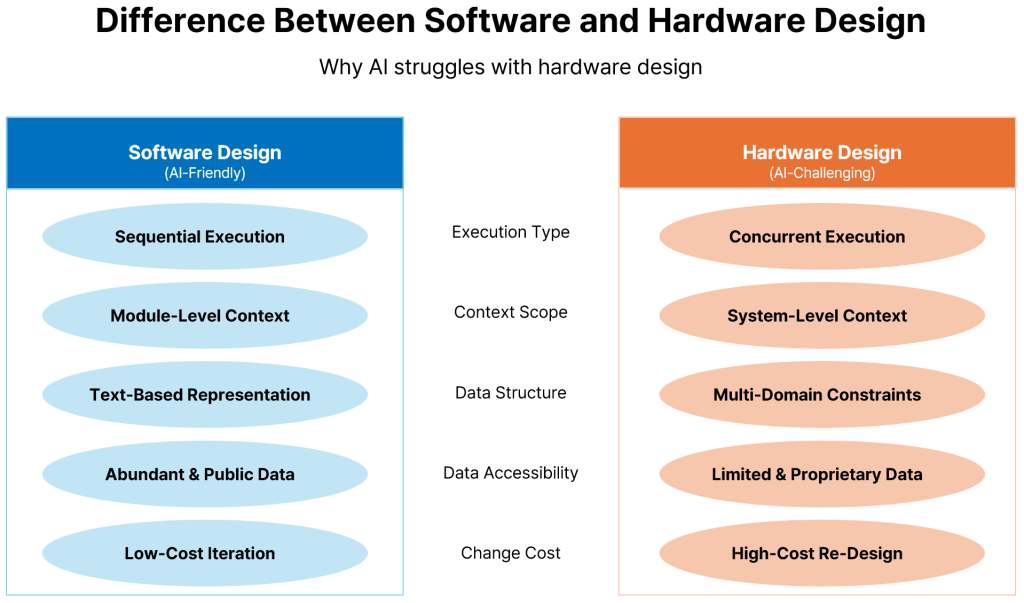
1. Software is sequential, whereas hardware is concurrent.
AI is fundamentally strong at processing tasks in a sequential order, such as text.
However, since hardware is structured so that multiple operations occur simultaneously, it is difficult for AI to understand this concurrency.
2. Context management is difficult.
In systems with concurrency, the entire context must be considered together.
However, it is even more challenging for AI, which is vulnerable to concurrency, to manage the overall context of such structures.
3. It possesses multidimensional data structures.
While software can be designed using text-based linear representations even with complex structures,
hardware is a multidimensional constrained system where timing, power, and physical constraints are strongly combined.
These constraints must be satisfied simultaneously.
Furthermore, such multidimensional data is not only difficult to learn, but a change in a single line of code can alter all the data.
4. There is a lack of training data.
While software code is widely available in public repositories like GitHub, semiconductor design data is mostly held internally within companies.
On top of that, the data is more complex and harder to learn from.
5. The cost of design modifications is extremely high.
n software, bugs can be fixed and updated. But in hardware, once a chip is manufactured, it cannot be changed.
If there is an error, the entire chip must be redesigned and produced again.
Since this process requires enormous time and cost, a virtually 0% error rate is required in semiconductor design.
Unless all these problems are resolved,
it may not be easy for AI to fully perform semiconductor design.
It is not that AI is lacking,
but rather that the nature of the problems it attempts to solve does not align with AI.
If so,
is it truly impossible to introduce AI into semiconductor design?
소프트웨어 분야에서는 AI(LLM)의 도입으로 설계 생산성이 급격히 변화하고 있습니다.
“신입 개발자는 필요 없다.”
“혼자서 10명 몫을 한다.”
“빅테크에서 해고가 시작됐다.”
라는 기사들이 쏟아지고 있습니다.
이 모든 기사가 사실이 아니라고 하더라도,
AI가 소프트웨어 개발의 생산성을 크게 변화시키고 있다는 점은 이미 많은 엔지니어들이 체감하고 있을 것입니다.
그렇다면 한 가지 질문이 생깁니다.
왜 반도체 설계에서는 아직 이런 이야기가 나오지 않을까요?
이 문제는 단순한 기술의 문제가 아니라
문제의 구조 자체가 다르기 때문입니다.
제가 생각하는 이유들은 다음과 같습니다.
1. 소프트웨어는 순차적이지만, 하드웨어는 동시적입니다.
AI는 기본적으로 텍스트처럼 순서대로 처리하는 문제에 강합니다.
하지만 하드웨어는 여러 동작이 동시에 일어나는 구조이기 때문에, AI가 이런 동시성을 이해하는 것이 쉽지 않습니다.
2. Context 관리가 어렵습니다.
동시성을 가진 시스템에서는 전체 Context를 함께 고려해야 합니다.
하지만 동시성에 취약한 AI가 이러한 구조의 전체 Context를 관리하는 것은 더욱 어렵습니다.
3. 다차원 데이터 구조를 가집니다.
소프트웨어는 복잡한 구조를 가지더라도 텍스트 기반의 선형 표현으로 설계가 가능하지만,
하드웨어는 타이밍, 전력, 물리적 제약이 강하게 결합된 다차원 제약 시스템입니다. 이러한 제약을 동시에 만족해야 합니다.
게다가 이런 다차원 데이터는 학습하기 어려울 뿐 아니라 코드한 줄의 변경에도 모든 데이터가 변경이 될 수 있습니다.
4. 학습 데이터가 부족합니다.
소프트웨어 코드는 GitHub 같은 공개 저장소에 많이 존재하지만, 반도체 설계 데이터는 대부분 기업 내부에 있습니다.
다차원 데이터라 학습하기도 더 어려운데, 학습할 데이터도 훨씬 부족한 상황입니다.
5. 설계 수정 비용이 너무 큽니다.
소프트웨어는 문제가 발생하더라도 수정 후 다시 배포할 수 있습니다.
하지만 하드웨어는 한 번 생산되면 수정이 불가능하며, 문제가 발생할 경우 전체 칩을 다시 설계하고 생산해야 합니다.
이 과정에는 막대한 시간과 비용이 소요되기 때문에, 반도체 설계에서는 사실상 오류율 0%가 요구됩니다.
이러한 문제들을 모두 해결하지 않는다면
AI가 반도체 설계를 전면적으로 수행하는 것은 쉽지 않을지도 모릅니다.
AI가 부족한 것이 아니라,
풀려고 하는 문제의 형태가 AI와 맞지 않는 것입니다.
그렇다면,
반도체 설계에 AI를 도입하는 것은 정말 불가능한 일일까요?